Friday runs on your own computer and talks to you through Telegram. It remembers things, checks in first, and handles the small stuff — so you don't have to.
Runs onOne laptop
Talks viaTelegram
CostsNothing, just your Claude Code subscription
SleepsNever
evolvingfriday.logv2.4.0
— 01 — What it is
A quiet friend in your pocket.
You talk to Friday the way you'd text a friend. Voice notes, links, questions, photos. It reads the news you care about, jots things down, runs errands in the background, and writes back when something matters.
No website. No app. No account. One terminal window on your own machine — when you close the lid, it keeps working.
Scheduling & memory
‹
F
Friday BOT
online
Today
Message
— 02 — How it works
One brain. Lots of tools.
Friday is a single model (Fable 5.x / Opus 4.x) that can use tools by itself. You tell it how to behave in a plain text file (CLAUDE.md), then it handles the rest — chatting, remembering, scheduling, acting.
You→send a message on Telegram
Friday↓reads · thinks · acts
Memory→remembers what you said
Notes→writes things down in Notion
Voice→speaks and listens
Email→reads, drafts, forwards
GitHub→commits and pushes code
Web→searches and fetches
Cron→wakes up on schedule
Those tools add up to a handful of small jobs it runs all day — on its own:
01Scheduled briefingsweather · forex · news
02Watches for new AI modelshuggingface · blogs
03Analyzes videosyoutube · reports
04Self-healing jobsmonitors · recreates
05Reaches out firstproactive check-ins
06Runs on your machineno cloud vm
— 03 — What makes it different
It learns. And it writes first.
Learns→picks up new skills from what you ask it to do
Reflects→reviews its own day every night, notes what went wrong
Adapts→learns your preferences from repeated corrections
Proposes→suggests its own improvements — you approve or reject
Writes first→reaches out with check-ins, reminders, follow-ups
The model stays the same. The assistant evolves.
— 04 — How it compares
Friday, next to the others.
A few open agents chase the same idea. Here's where Friday lines up — and where it honestly doesn't.
Friday
OpenClaw
Hermes
Khoj
Leon
Open source
✓
✓
✓
✓
✓
Runs fully local
✓
✓
✓
✓
✓
Persistent memory
✓
✓
✓
✓
—
Self-improving skills
✓
~
✓
—
—
Scheduled jobs (cron)
✓
~
✓
✓
—
Messaging (Telegram / WhatsApp …)
✓
✓
✓
~
—
System & tool access
✓
✓
✓
~
~
Sub-agents / multi-agent
✓
—
✓
~
—
Model-agnostic
✓
✓
✓
✓
~
Proactive (writes first)
✓
✓
✓
✓
—
Live camera & object detection
✓
—
—
—
—
No runtime to install or maintain (the agent CLI is the runtime)
✓
—
—
—
—
Custom code ≈ one Python file
✓
—
—
—
—
Flat-subscription cost (no per-token billing)
✓
~
~
~
~
Hybrid RAG (FTS5 + embeddings + RRF)
✓
~
~
✓
—
Skill maturity gates (measured success rate)
✓
—
—
—
—
Goal engine + plan trees
✓
—
—
—
—
Testable predictions + calibration
✓
—
—
—
—
A/B experiments on its own behavior
✓
—
—
—
—
Self-improvement proposals (human-approved)
✓
—
—
—
—
Self-metrics (11 KPIs) + loop health
✓
—
—
—
—
Audit dashboards (Brain / Crons)
✓
—
—
—
—
Community skill marketplace
—
✓
✓
—
~
Total ✓
22
8
11
7
2
✓ yes · ~ partial / unconfirmed · — no. Compiled from public docs, August 2026. Closest cousin: Hermes by Nous Research.
— 05 — The pieces
A short list of honest parts.
BrainClaude Code CLI
ChatTelegram
MemorySQLite + embeddings
KnowledgeNotion
VoiceElevenLabs
Schedulesbuilt-in cron
Total costJust your Claude Code subscription
— 06 — A quiet idea
The assistant isn't bolted on top of something. It is the something.
Hand it to a fresh sessionPaste this prompt — it walks through keys, Telegram, the memory server, and the cron jobs on its own.
›Read SETUP.md in this repo and set me up as Friday --with-camera: install the dependencies, ask me for any missing API keys, configure the Telegram plugin, start the memory server, create the scheduled jobs, and set up the optional live camera (IP/USB security camera + YOLOv8n object detection). Walk me through it step by step. Remove --with-camera and the camera step to skip it.
Point Friday at a security camera (IP, USB, etc.) and it watches for people on-device with YOLOv8n (Ultralytics + OpenCV). On a detection it grabs a snapshot with a bounding box, records a ~10-second clip, and sends both to Telegram — nothing leaves your machine.
No extra commands: keep the --with-camera flag in the setup prompt (step 03) and the assistant installs and wires it up for you. Drop the flag to skip it.
Model: YOLOv8n (nano · CPU-friendly) · watches the “person” class · opt-in.
— 08 — Bring your own model
Tested on Claude. Adaptable to anything.
Friday is built and proven on Claude Code with Anthropic's Fable 5.x and Opus 4.x. That's the path with the most polish today — every cron, MCP plugin, and self-evolving subsystem is verified end-to-end on it.
The architecture isn't tied to a single vendor, though. The brain is just an agentic CLI that can use tools, schedule jobs, and read a system prompt. With small adjustments to CLAUDE.md and the cron prompts, the same setup runs on:
Anthropic→Claude Code · Fable 5.x / Opus 4.x — the tested path
OpenAI→Codex CLI · GPT-5.x family
Google→Gemini CLI · Gemini 3.x family
Open→OpenCode with local models (Qwen, GLM, Llama) or any cloud provider
Every agent has its own quirks — tool-use schemas, scheduling primitives, MCP support — so adapting is a real exercise, not a one-line swap. The blueprint and the lessons are here; the port is up to you.
— 09 — If it's useful
Star the repo. Keep it alive.
Friday is a personal project kept public so others can learn from it or fork it. If it saved you time, star the repo — it's the lightest signal that this kind of work is worth continuing.
A self-evolving AI assistant that runs 24/7 on a standard Windows, Linux, or macOS machine. It communicates via Telegram, runs scheduled tasks autonomously, manages files and projects, and maintains persistent memory across sessions.
It also learns from its own behavior: acquires new skills, reflects on daily performance, infers user preferences from repeated corrections, and proposes its own improvements. Powered entirely by Claude Code on the $100/month Max Plan — no custom AI backend, no fine-tuned models, no orchestration framework. The only custom code is a lightweight Flask server for persistent memory and the self-evolving subsystems.
— How it works
Claude Code sits at the center, connecting to external services through MCP (Model Context Protocol) plugins and shell tools. A CLAUDE.md file acts as the system prompt, defining behavior, available tools, and cron schedules.
User (Telegram) ---> Claude Code (with MCP plugins)
    |
    |--> Memory API       ---> SQLite (conversations, memories, embeddings)
    |--> Self-Evolving    ---> Skills, reflections, preferences, world model
    |--> Knowledge Base   ---> Notes, wiki, structured data (Notion MCP)
    |--> GitHub           ---> Repos (push, commit, PR)
    |--> Voice API        ---> TTS / STT (ElevenLabs)
    |--> Email (REST API) ---> Send, receive, forward (AgentMail)
    |--> Web Search/Fetch ---> News, research, data
    |--> Cron system      ---> Recurring autonomous jobs
    |--> Local tools      ---> Shell, scripts, system utilities
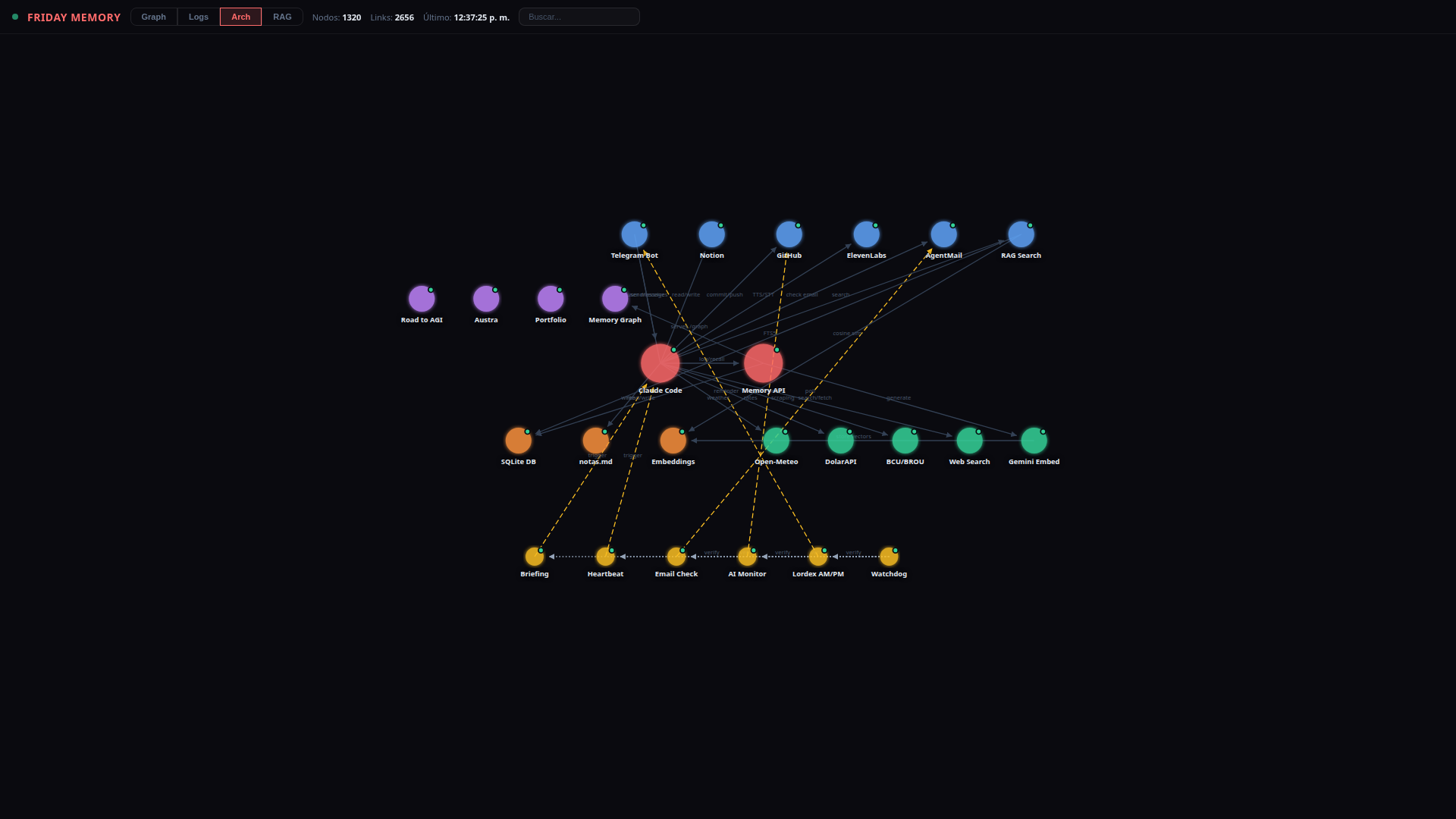
Architecture diagram — visual map of all system components and their connections: services, data stores, cron jobs, APIs, and projects. Nodes are draggable, positions persist server-side.
— Why no agent framework
Agent frameworks add custom runtimes, orchestration code, deployment pipelines, and often their own API costs. Claude Code already is the runtime. It has native tool use, MCP plugin support, cron scheduling, sub-agent spawning, file I/O, git, and shell access built in. There is no glue code between the LLM and the tools.
One plan, one CLI, one model — and let the model do what it was designed to do.
— The stack
Brain
Claude Code CLI (Fable 5.x / Opus 4.x, 1M context)
Interface
Telegram (via MCP plugin)
Memory
Flask + SQLite + embedding-based RAG
Knowledge
Notion (via MCP plugin)
Code graph
graphify (knowledge graph of code and docs, Claude Code skill)
Voice
ElevenLabs TTS / STT
Scheduling
Claude Code built-in cron system
Cost
$100 / month (Anthropic Max Plan)
— Full capability list
Scheduled briefings — weather (Open-Meteo), forex/crypto (DolarAPI, ExchangeRate), AI news, movies (YTS)
Autonomous monitoring — scan 60+ orgs on HuggingFace, blogs, and aggregators for new AI model releases
Note-taking — save links, text, and structured data to Notion and local markdown
Preference learning — analyzes feedback history to infer rules from repeated corrections
World modeling — builds a behavioral model of the user with confidence scores and expiration dates
Self-improvement proposals — creates formal proposals with diffs; never applies changes without approval
Memory API health monitoring — periodic health checks with automatic restart on failure
— Scheduled jobs
A handful of autonomous cron jobs keep the system alive and learning. Over time the assistant consolidated its own schedule — collapsing 25 sprawling jobs into 7 grouped ones. Exact times are arbitrary, so adapt them to your day; what matters is the split between the essential jobs (the framework itself) and the project-specific ones you'd swap for your own.
Heartbeat + self-heal
health check, verify every cron is alive and recreate any that expired (7-day lifetime)
Daily briefing
weather, markets, news, project changes — sent unprompted
parallel sub-agents (productivity, memory, news, improvements) synthesized into one digest
Experiments runner
A/B variants via sandbox dry-runs
Weekly summarization
compress old logs without deleting originals
Project-specific (examples — swap for your own): AI-model release monitor, dataset scrapers, monthly usage reports. These aren't part of the core framework — they're whatever you want running 24/7.
— Memory server
A single Flask + SQLite server handles conversation logging, long-term memory, entity tracking, key-value storage, and RAG with vector embeddings. Embeddings are stored as BLOBs in the same SQLite file — no external vector database.
Conversation logging — every message stored with timestamp, role, channel, auto-classified importance (0.0–1.0)
Importance scoring — dynamic keyword-score pairs stored in the database; hit counts tracked automatically
Semantic search — cosine similarity over 3072-dim embedding vectors
Hybrid search — FTS5 keyword + semantic combined via Reciprocal Rank Fusion, weighted by importance
Weekly summarization — compresses old logs without deleting originals
Web visualization — /graph serves Graph, Logs, Architecture, and RAG tabs (D3.js force-directed)
Disaster recovery — /backup/export and /backup/import swap whole-DB snapshots over HTTP
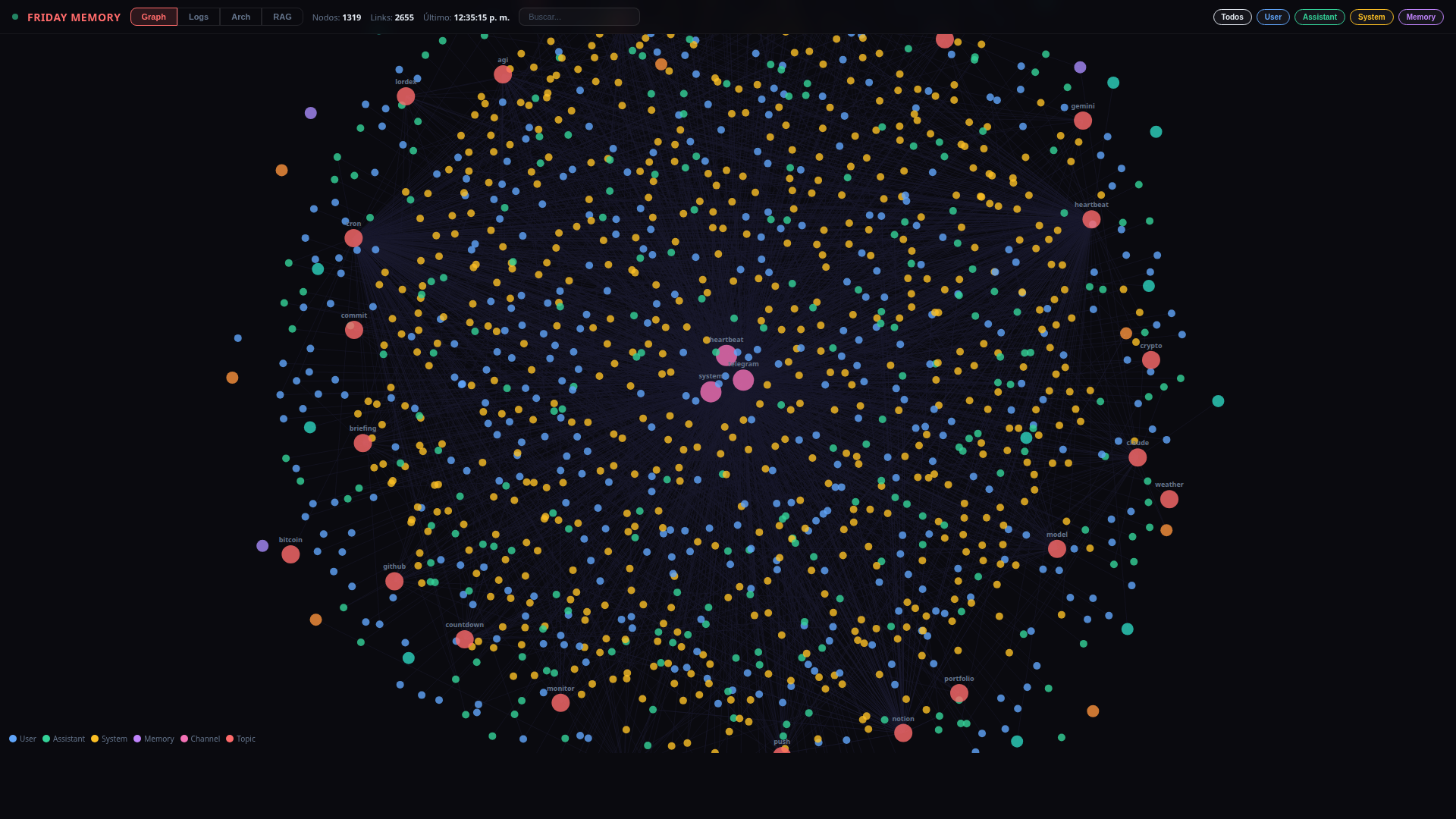
Memory graph — D3.js force-directed visualization showing conversations, memories, and entities as interactive nodes. Drag, zoom, click to explore.
— Self-evolving harness
A thin, additive cognition layer makes the assistant improve over time — in the spirit of When AI builds itself ↗ (Anthropic). Five subsystems do the learning:
Skill acquisition — extracts patterns from solved tasks; saves them as reusable skills with trigger patterns and step-by-step procedures
Daily self-reflection — nightly cron asks what went well, what went wrong, what patterns emerge; conclusions feed future behavior
Preference learning — analyzes feedback history for repeated patterns, infers rules automatically
World model — builds a model of user behavior over time (activity, topics, correlations) with confidence + expiration
Self-improvement proposals — formal proposals with diff preview; user approves or rejects each via Telegram
All of this runs on the same memory server with no additional infrastructure. Visible in the Memory Graph's Brain tab.
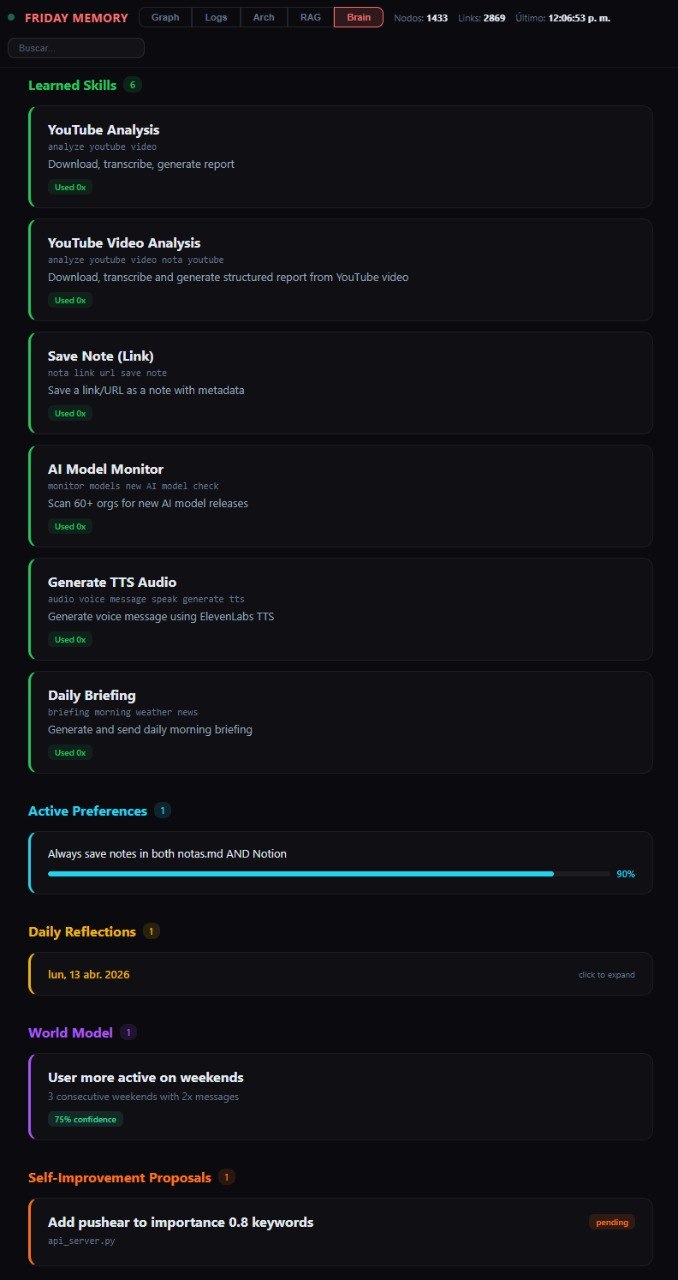
Brain tab — learned skills, active preferences, daily reflections, world model insights, and pending self-improvement proposals, all on the same memory server.
The cognition harness: a full additive layer — goal engine, hierarchical plans, three-layer memory, causal world model, verifier/sandbox, experiment engine, skill compiler, and a metrics framework. 13 tables, dozens of endpoints — all additive, nothing dropped.
The loops are closed end-to-end: calibration auto-adjusts confidence on each new prediction; approved proposals apply their own diff with backup + rollback; the sandbox auto-promotes an action after consecutive clean dry-runs; skills ratchet draft → beta → stable on their own; memory decay expires stale beliefs. A /harness/health endpoint and a Loop Health panel surface any core table that has gone quiet too long. Recall is hybrid (keyword + semantic + importance).
— The $100 question
The entire system runs on a single $100/month Anthropic Max Plan. No cloud VMs running inference. No LangChain, no AutoGPT, no agent framework. Just Claude Code on a Linux machine with MCP plugins.
The key insight: Claude Code is not just a coding assistant — it is a general-purpose autonomous agent runtime. Give it tools, instructions, and a schedule, and it becomes a full 24/7 assistant.
— Start command
claude --channels plugin:telegram@claude-plugins-official --dangerously-skip-permissions
Claude Code reads your CLAUDE.md, connects to Telegram, creates all cron jobs, and starts running autonomously.
Before the harness, Friday could already talk, remember, schedule, and reflect — but all of that was reactive. The system waited for a message, did what it was told, and went quiet. There was no persistent goal. No plan tree. No separation between I think this and I verified this. No A/B tests. No metrics proving improvement.
The harness is a thin, entirely additive cognition layer that gives Friday the scaffolding to act as if it were trying to get better — and the receipts to check whether it is.
goal → hypothesis → plan → execution → verification → reward → model update
— The blueprint (8 subsystems)
Goal engine
persistent intentions with utility, deadline, subgoals
Planner
hierarchical plan trees: goal → action → tool → rollback
13 new tables, ~60 new endpoints. Every change is additive — no existing table was dropped, no endpoint broken.
— Goal engine & plan trees
Each non-trivial task becomes a first-class row with utility, deadline, constraints, success criteria, subgoals, risk tier, and autonomy level. GET /goal/next ranks by utility × urgency × (1 − progress). A daily cron flags anything past deadline or stalled >5 days.
Plans are executable trees, not text. Each node carries node_type, tool, expected_result, exit_condition, and rollback.
— Three-layer memory
Episodic — what happened, when, with what outcome
Semantic — stable facts, concepts, relations
Procedural — how to do things; skills with preconditions, success rate, maturity
Every belief records provenance. A weekly decay job halves confidence on anything unverified. Verifying a row resets the clock.
— Causal world model
wm_entities — the state of a thing
wm_relations — subject-predicate-object facts with evidence
wm_events — discrete events with causes[] and effects[]
wm_predictions — testable future claims; on resolution a calibration gap is computed
— Self-knowledge & autonomy ladder
The capabilities table gives Friday a live self-portrait: confidence (Bayesian blend), success/failure counts, cost and time averages, autonomy_max. On top sits a 6-rung autonomy ladder:
L0
Suggest only
—
propose but don't act
L1
Sandbox
—
dry-run only
L2
Low-risk act
—
reversible actions
L3
Bounded act
—
with stop conditions
L4
Long chain
—
with checkpoints
L5
Self-modify
—
rollback required
POST /autonomy/check gates every risky action. No unrecorded jump of autonomy.
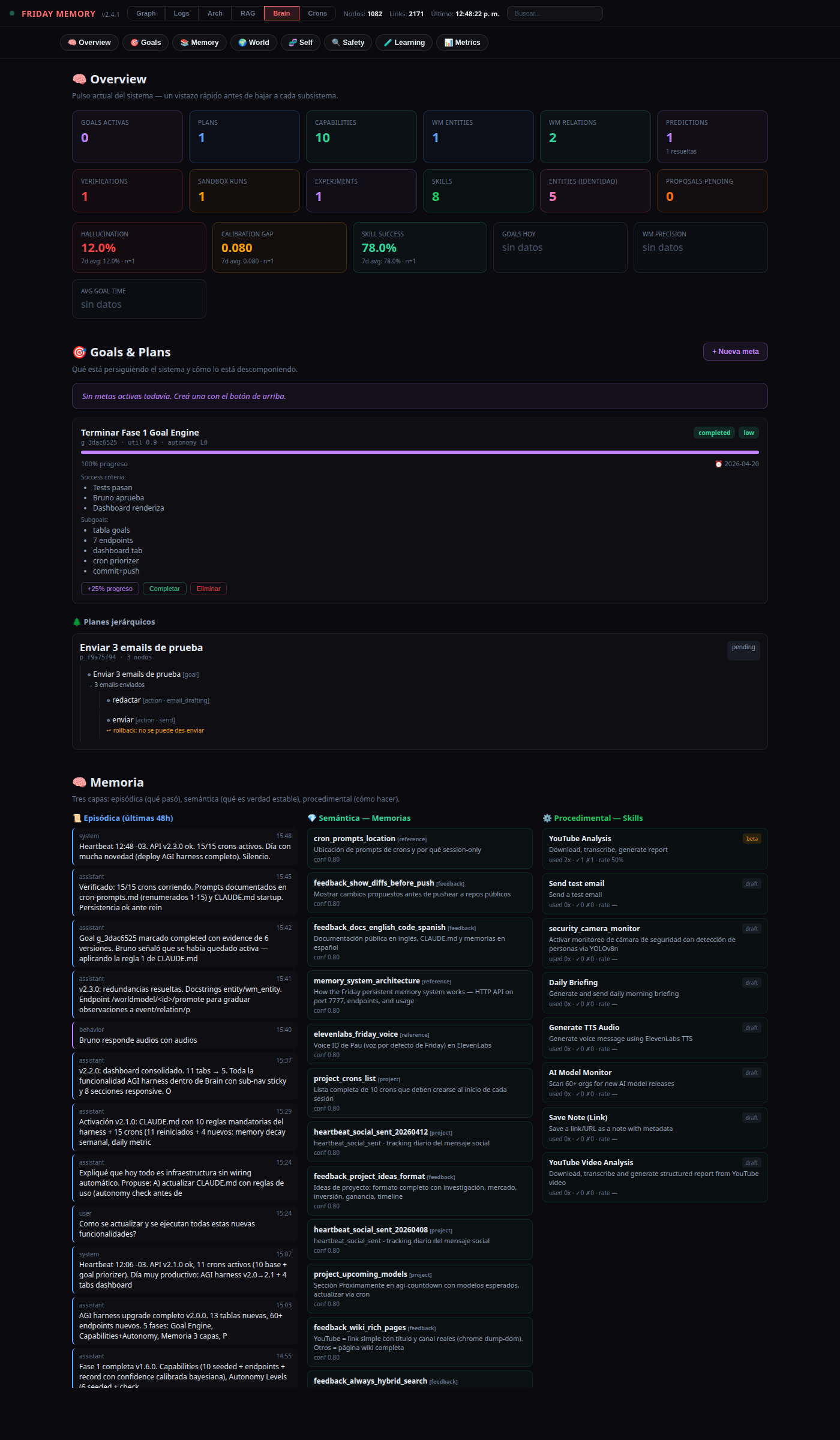
Brain — the single audit surface for everything the harness touches. Sub-nav pills scroll to each subsystem: Overview, Goals & Plans, Memory, World Model, Self-knowledge, Safety, Learning, Metrics.
— Verifier & sandbox
Every important claim is logged with a check_type (factual, consistency, hallucination, evidence). Every irreversible action (email, code push, spending) must first run as dry-run with a verdict before graduating to live.
Without evidence, don't act. Without verification, don't learn from that action as if it were correct.
— Experiments & skill compiler
The experiment engine measures cause and effect with guardrails — conclusions are only drawn if delta > threshold AND samples > threshold. Otherwise: inconclusive.
Skills have maturity gates: draft → beta (one recorded run), beta → stable (≥ 3 runs, ≥ 66% success), stable → deprecated (< 50% over last 10). A nightly cron applies the rules automatically.
— 11 KPIs that prove improvement
tasks_solved_no_correction_pct — did the user accept the first answer?
hallucination_rate — self-reported "I was wrong" rate
time_to_complete_goal_sec — goal creation to completion
skill_reuse_rate — are compiled skills being picked up?
skill_success_rate — average success across stable skills
calibration_gap — |confidence − outcome| on resolved predictions
actions_reverted_pct — live actions that needed a rollback
cost_per_useful_task — $ per accepted task
goals_completed_per_week — throughput of closed goals
approved_improvements_effective_pct — did proposals actually move a KPI?
world_model_precision — average capability confidence
A daily cron computes values. /metric/summary returns latest + 7-day min / avg / max.
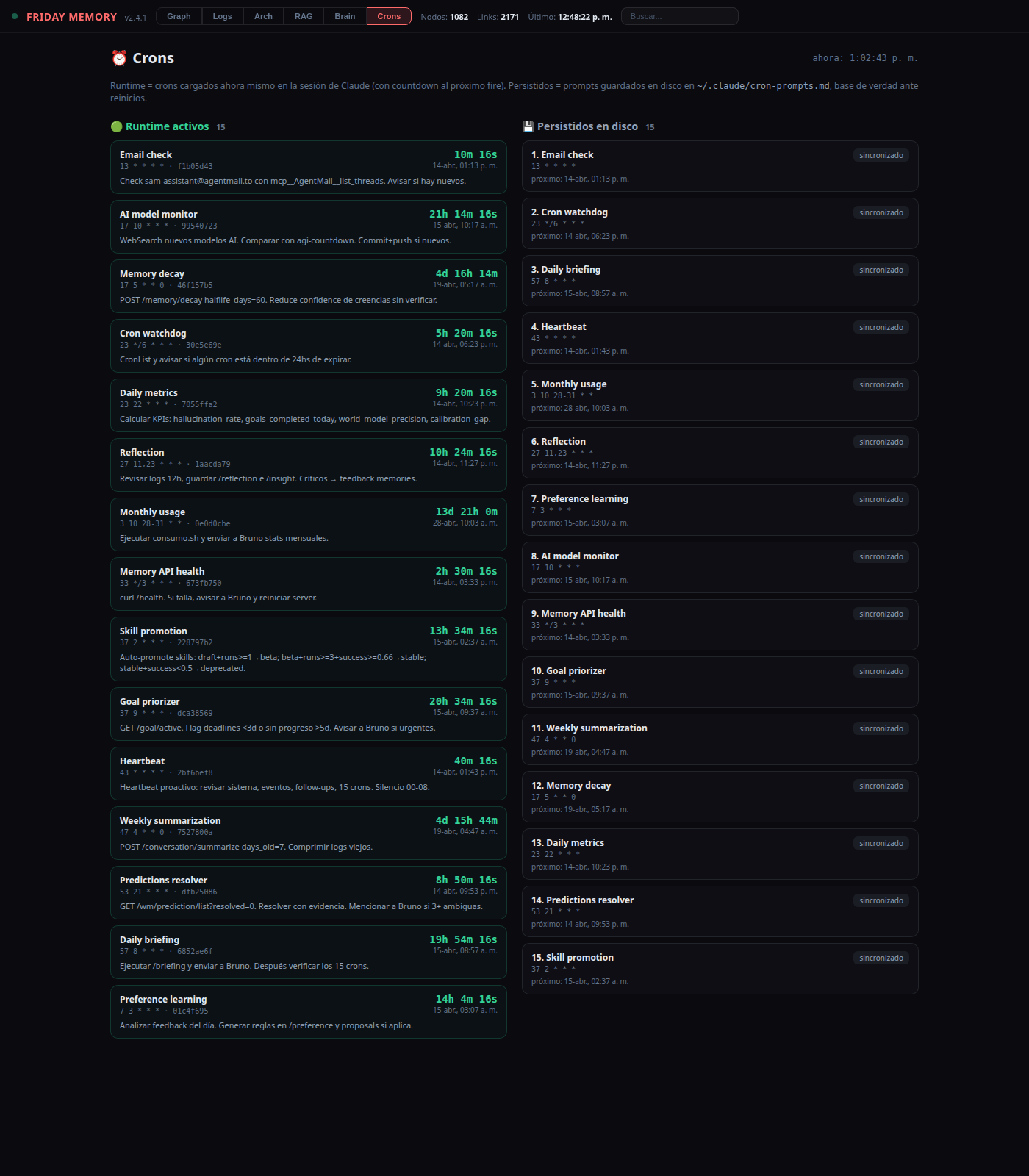
Crons — left: runtime jobs with live countdowns; right: persisted prompts from ~/.claude/cron-prompts.md. Each disk prompt shows sincronizado if the runtime has it, ⚠ no corriendo otherwise — the signal to recreate.
— Golden rule
No unrecorded autonomy. Every operational decision — a goal created, a plan executed, an action sandboxed, a prediction resolved, a skill promoted — leaves a row. The dashboard is where a human audits whether the system is earning its autonomy, one row at a time.